🔬 RamanBench Leaderboard
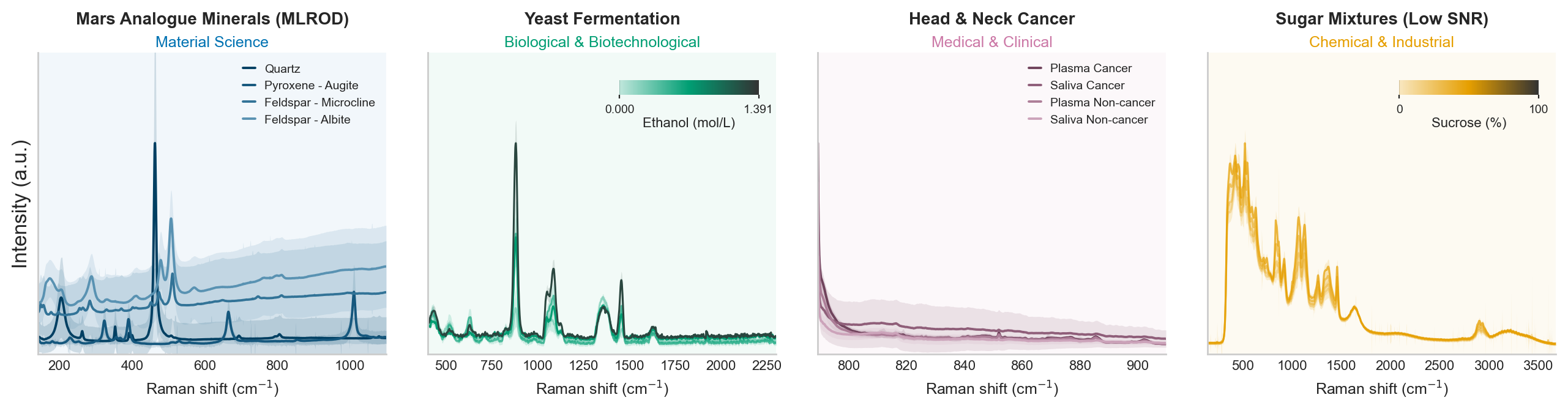
RamanBench benchmarks machine learning on Raman spectra: 61 public datasets with 135 prediction targets (21 classification, 114 regression, 327,542 spectra) from four application domains (Material Science, Biological, Medical, Chemical), measured on many different instruments. The 61 models range from PLS, the long-standing spectroscopy default, through gradient boosting and deep networks to Raman-specific architectures and tabular foundation models. AutoGluon (extreme preset, 5 min and 1 h) is shown as a reference, not ranked.
Elo is calibrated so Random Forest = 1000.
Win rate is the share of pairwise comparisons a model wins per target.
Improvability is the mean relative gap to the best model per target (lower is better).
Score is the normalized error: best model per target = 1, median = 0.
v1.4 · archived v0.1 leaderboard
Left: RamanBench datasets (pink) sit in a high-dimensional, low-sample regime that tabular benchmarks (TabArena, TALENT) and time-series archives (UCR, UEA) barely cover. Right: Elo of each model over its release date (all tasks); the staircase is the best model released so far. The detailed version is further below.
61 datasets and 327,542 spectra by application domain and task type, where the data is hosted, and how many datasets were first published with RamanBench. Classification datasets are a third of the datasets but most of the spectra.
Leaderboard
Ranking over all 135 targets. Models marked (clf. only) / (reg. only) run one task type only and are evaluated on that subset. AutoGluon rows (italic) are a reference and take no rank.
† RamanPFN (known contamination): Developed on the RamanBench v0.1 datasets and splits (Pan et al., 2026, arXiv:2608.02157), so its scores may be optimistic.
‡ Chakra-Tab full (API), Chakra-Tab (API): closed-source hosted API; the model and its code are not public (see Closed-source models).
(clf. only) / (reg. only): the model runs one task type only and is evaluated on that subset (see Tasks). Its Elo comes from comparisons on those tasks, on the same Random Forest = 1000 scale; its other columns are from that task type's leaderboard. Nothing is imputed for the other task type.
More figures
All figures are interactive: hover for values, click legend entries to hide models, and use Top k per category / All in colour where offered.
Elo per task type, classification (top) and regression (bottom), with 95% bootstrap confidence intervals. Random Forest = 1000. Hatched bars have imputed results. Dashed lines: AutoGluon (extreme preset) with 5 min and 1 h budgets.
Normalized score (best model per target = 1, median = 0) against median train + predict time per 1,000 spectra, log scale. Upper left is better. Coloured: the top 2 models per category and every Pareto-optimal model; the line is the Pareto front.